Last Click vs First Click in Affiliate Programs
Attribution decides which publisher in a customer's path gets paid, and the default is last click almost everywhere. Impact names it the industry standard, Semrush and Notion state it outright, and Awin layers a cookie hierarchy on top. Webflow is the exception that publishes first-touch. Here is what each page says, as of October 2026.
This article is a documentation review: it is based on the vendors' own published pages, checked on the date shown. We may earn a commission from some links; it never affects what we recommend.
Two publishers can send the same customer, and only one gets paid. The rule that decides which one is the credit policy, and it is set by the brand inside the network rather than negotiated with you.
Last click is the default nearly everywhere: Impact calls it the recommended policy and the industry standard, Semrush and Notion state it on their program pages, and Kinsta describes last-touch. Webflow publishes first-touch instead, which flips the arithmetic for review publishers.
Awin adds a layer most publishers never see, ranking the type of cookie before it ranks the timing. Every rule below was read from the vendor's own documentation on October 21, 2026.
Last click is the default, and the documentation says why
Impact's credit policies overview states that by default impact.com attributes conversions on a last-click basis. Each event type in a program uses one of three credit policies to set its attribution logic.
Its dedicated page goes further. Last Click is the default credit policy for all brands on impact.com, is the recommended policy to use, and is considered the industry standard. The partner that drove the last click receives 100 percent of the credit.
Brands on the network inherit that language. Notion's affiliate FAQ states that commissions are paid on a last-click basis, so your link must be the last touch point before the user signed up.
Semrush, which also runs on Impact, publishes the pair together: last-click attribution and 120 days of cookie life. Kinsta publishes a 60-day tracking cookie with last-touch attribution.
For a review publisher this is usually the friendly setting, because a comparison page is often the final checkpoint before signup rather than the first discovery. The cookie side of the same question is in how affiliate cookie windows compare.
Webflow is the exception worth studying
Webflow's affiliate page lists its general details in four lines, and the first reads: first-touch attribution and 90-day cookie window. It is the only first-touch program among the pages we read.
The second line narrows it further. Commissions are earned on a new customer's first eligible subscription only, against a published rate of 50 percent of that first subscription for up to 12 months.
First touch rewards the page that introduced the product. A publisher who ranks for early-stage queries benefits, while one who ranks for a late-stage comparison term can lose a sale they effectively closed.
Webflow also excludes its own channel conflicts, stating that the program does not offer payouts on one-to-one referrals and that client purchases are not eligible, which is a distinction covered in affiliate vs referral vs partner programs.
First click needs a lookback window to mean anything
Impact's first-click documentation explains the missing piece. A major difference between First Click and the others is the need to set a lookback window, which sets how far back the platform should look for the first click in the path.
The consequence is published too. A lookback window set for 90 days will only look 90 days back from the conversion, and the partner that drove the earliest click in that window wins credit even if the true path took longer.
So first click does not mean the genuine first touch. It means the earliest click inside a window the brand chose, which is why Impact describes the policy as not recommended for most implementations and limited to specific editions.
Impact's third option, Last to Cart, gives credit to the partner who drove the final add-to-cart. It requires a manual tracking tag implementation and is not supported by the Shopify, WooCommerce or BigCommerce app integrations.
Awin ranks the cookie type before it ranks the clock
Awin's attribution article states that it typically applies last contact wins with a cookie hierarchy. Clicks come first, soft clicks second, and post-view cookies last.
The detail matters. A soft click cookie, used by tech plugin and browser extension partners, only wins if no other valid last click exists. A standard or incentive click overwrites it.
Post-view sits at the bottom. If a user both sees a display ad and later clicks an affiliate link, Awin states the click takes priority. The ordering is validated automatically at the point of transaction.
That hierarchy is why a content publisher can lose a sale to a cashback extension but not to a banner impression. Which link earned it is only visible if you have tagged it, as how sub IDs show which page earned a commission explains.
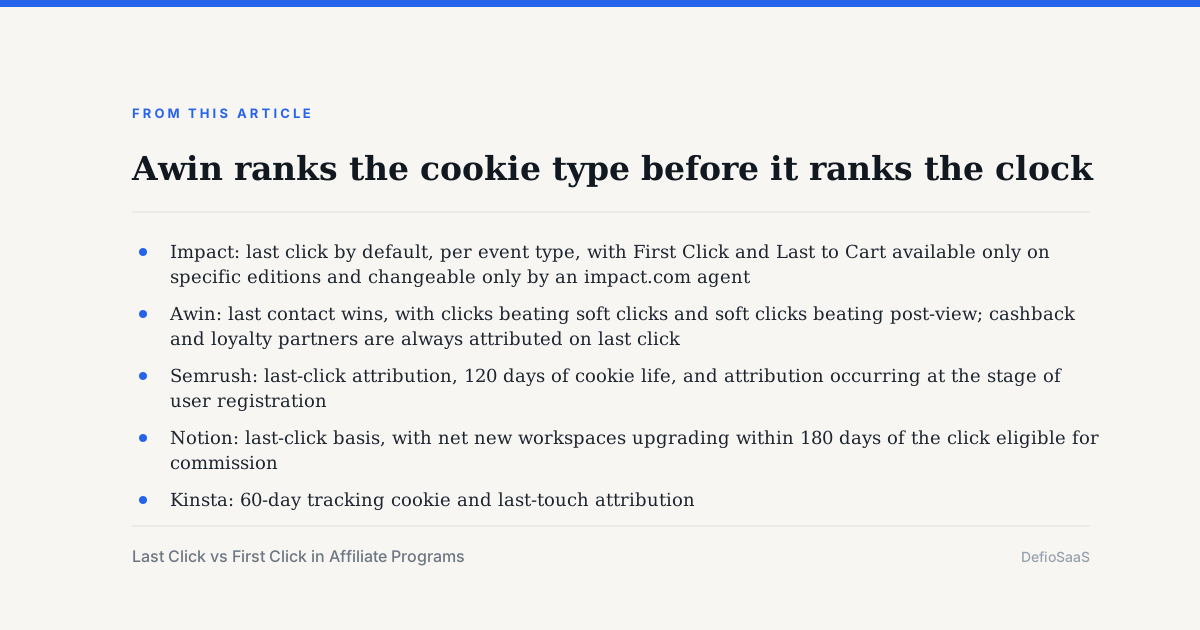
- Impact: last click by default, per event type, with First Click and Last to Cart available only on specific editions and changeable only by an impact.com agent
- Awin: last contact wins, with clicks beating soft clicks and soft clicks beating post-view; cashback and loyalty partners are always attributed on last click
- Semrush: last-click attribution, 120 days of cookie life, and attribution occurring at the stage of user registration
- Notion: last-click basis, with net new workspaces upgrading within 180 days of the click eligible for commission
- Kinsta: 60-day tracking cookie and last-touch attribution
- Webflow: first-touch attribution, 90-day cookie window, first eligible subscription only
- Shopify: referrals tracked for 30 days from the click, with free trials tracked through to paid and full price for up to 400 days
One brand can run more than one rule
Awin's Attribution Manager lets an advertiser define custom rules, and one of its parameters is click preference: whether matched clicks are sorted using first click or last click logic. The tool is limited to Awin Advanced customers on Awin Classic.
Those rules run in priority order. Awin evaluates the highest-priority rule, moves to the next if no click matches, and falls back to the default attribution rule if none match at all.
One carve-out is published. Clicks from partners whose primary type is cashback or loyalty are always attributed on a last-click basis, since users expect a clear incentive.
Impact's equivalent lever is the event type.
Because each event type carries its own credit policy, a single program can credit a trial signup one way and a paid upgrade another, and the policy sits beside the tier rules in how SaaS affiliate tiers and bonuses work.
The window that applies is the one live when the click happened
Impact's referral window article sets out action-date logic. The referral window that applies is determined by the contract that was live when the tracked action took place, even if the contract has since been updated or replaced.
Its worked example is specific. A click on May 20 under a contract with a 15-day window converts by June 4, while a click on June 5 under a 1-day window converts by June 6.
Semrush publishes three reasons a referral is not attributed at all: the user did not use the affiliate link, the user did not accept the necessary cookies, or the user already had a registered Semrush account.
The last one is a structural limit rather than a timing one. Semrush states attribution occurs at the stage of user registration, so an existing account cannot be credited to you, a pattern covered in referrals SaaS affiliate programs will not pay.
Bottom line
Record the attribution model next to the cookie length, because one without the other tells you nothing. A 120-day last-click window and a 90-day first-touch window reward completely different pages.
If a program is last click, the comparison and pricing pages are the assets to build. If it is first touch, the explainer that ranks for an early query is worth more than the review that closes the sale.
Then check the exceptions in writing before you plan around them, as reading the terms before promoting recommends, because deduplication rules and cashback carve-outs are where credit quietly moves.
Frequently asked questions
Which attribution model do most SaaS affiliate programs use?
Last click. Impact states it is the default for all brands on its platform, the recommended policy, and the industry standard. Semrush, Notion and Kinsta all publish last click or last touch on their own program pages, checked October 21, 2026.
Does any SaaS program use first-click attribution?
Yes. Webflow's affiliate page lists first-touch attribution with a 90-day cookie window, and commissions earned on a new customer's first eligible subscription only. It was the only first-touch program among the pages we read.
Is first click the same as the genuine first touch?
No. Impact states that a first-click policy needs a lookback window, and that a 90-day window looks only 90 days back from the conversion. The earliest click inside that window wins, even if the real path started earlier.
Can a browser extension take credit for my sale?
On Awin, only if you left no click. Soft click cookies, used by tech plugin and extension partners, win only when no valid standard or incentive click exists, and a standard click overwrites them in the hierarchy.
Why did a referral not appear in my dashboard at all?
Semrush publishes three reasons: the user did not use your affiliate link, the user did not accept the necessary cookies, or the user already had a registered Semrush account. Attribution there happens at registration, so existing accounts cannot be credited.
Can a brand change its attribution model after I join?
It can change the rule, but Impact states the referral window that applies is set by the contract live on the action date, so clicks already driven keep their original window. Awin states new attribution rules take effect immediately once confirmed.
Sources
- impact.com Help Center: Credit Policies Overview (last-click default, three policies per event type) (checked Oct 21, 2026)
- impact.com Help Center: Last Click Credit Policy Explained (default for all brands, recommended, industry standard, 100% of credit) (checked Oct 21, 2026)
- impact.com Help Center: First Click Credit Policy Explained (lookback window, 90-day example, not recommended for most implementations) (checked Oct 21, 2026)
- impact.com Help Center: Last to Cart Credit Policy Explained (manual UTT trackCart required, not supported by Shopify, WooCommerce or BigCommerce apps) (checked Oct 21, 2026)
- impact.com Help Center: Referral Window Explained (action-date logic, May 20 and June 5 worked example) (checked Oct 21, 2026)
- Awin help: Awin cookie types and attribution hierarchy (last contact wins, clicks over soft clicks over post-view) (checked Oct 21, 2026)
- Awin help: Attribution Manager (click preference first or last click, rules in priority order, cashback and loyalty always last click) (checked Oct 21, 2026)
- Webflow Affiliate Program (first-touch attribution, 90-day cookie window, first eligible subscription only, 50% for up to 12 months) (checked Oct 21, 2026)
- Semrush Affiliate Program FAQ (last-click attribution, 120 days of cookie life, attribution at registration, three non-attribution reasons) (checked Oct 21, 2026)
- Notion Affiliate Program FAQ (last-click basis, net new workspaces upgrading within 180 days) (checked Oct 21, 2026)
- Kinsta Affiliate Program (60-day tracking cookie, last-touch attribution) (checked Oct 21, 2026)
- Shopify Affiliate Program FAQ (referrals tracked 30 days from the click, free trials tracked to paid and full price for up to 400 days) (checked Oct 21, 2026)