How to Read a SaaS Pricing Page Before You Promote
A pricing page is a marketing surface, not a fact sheet. Four live pages read from source on one day produced four different ways to misquote a price.
This article is a documentation review: it is based on the vendors' own published pages, checked on the date shown. We may earn a commission from some links; it never affects what we recommend.

A pricing page is a marketing surface, not a fact sheet. Four things on it move the number you are about to publish: the billing toggle, promotional strikethroughs, the phrase starting from, and the unit the plan is counted in.
This guide reads four live pricing pages and shows where each one can be misread. Every figure below was taken from the page source on November 5, 2026, not from a search result or a summary.
Find the billing toggle before you read a single number
The first number you see is usually the annual-billing price. On Notion's pricing page the billing control is a pair of radio inputs, and the one marked as selected in the page source is the yearly option.
Under that default, Notion lists Plus at $10 per member per month and Business at $20 per member per month. Both are annual-billed figures presented in monthly units.
The monthly-billed equivalents did not appear in the page source on November 5, 2026, because the card re-renders when the toggle changes. A buyer paying month to month will see different numbers at checkout.
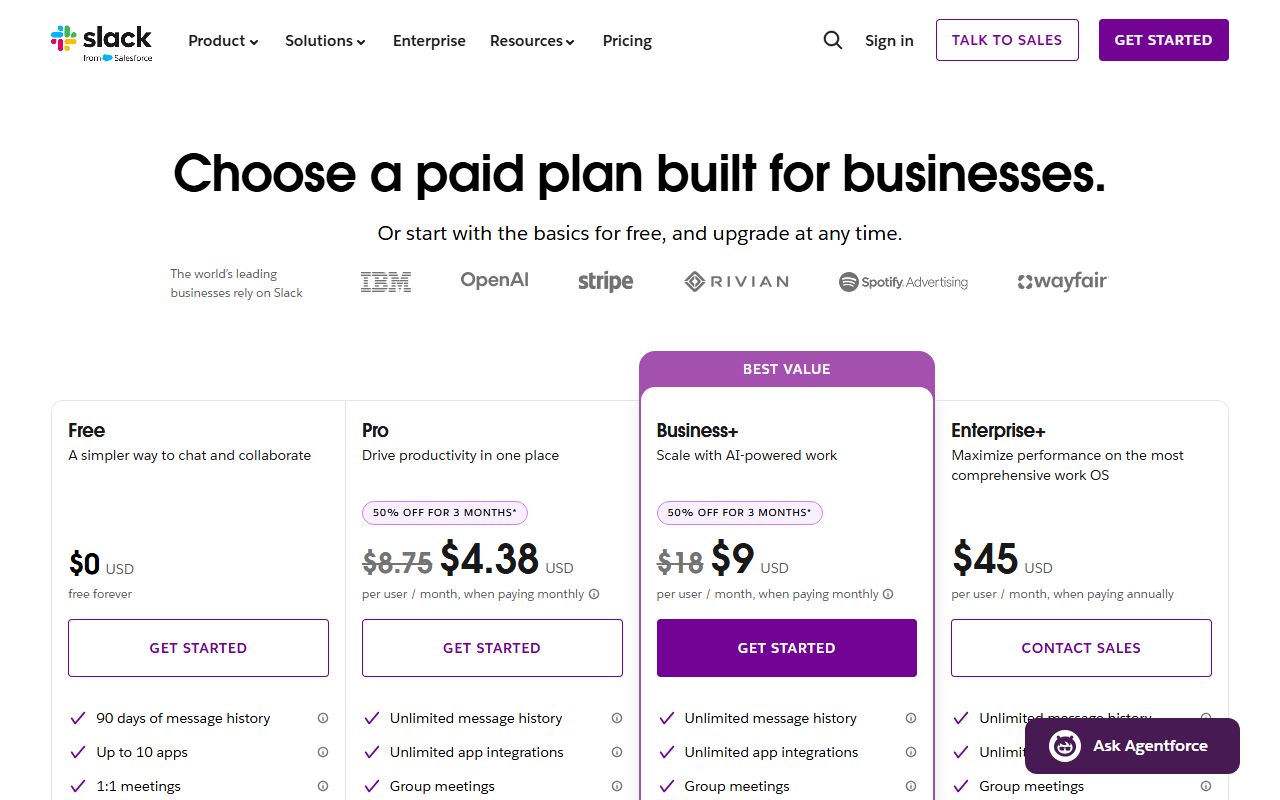
Slack's pricing page is easier to quote because it prints both. Pro is listed at $8.75 per user per month paying monthly and $7.25 paying annually. Business+ is listed at $18 monthly and $15 annually.
That is a gap of about 17 percent between the two Pro figures, by our own arithmetic on the published numbers. Quote the wrong one in a review and every cost comparison downstream inherits the error.
A promotional price is not the price you should quote
Slack's page also carries struck-through promotional pricing: $8.75 reduced to $4.38 per user per month for three months on Pro, and $18 reduced to $9 on Business+.
A three-month promotion is a real offer, but it is not the plan price. If you publish $4.38 as the cost of Slack Pro, your readers will budget wrong from month four onward.
Write promotional prices as what they are, with the duration attached. The same discipline applies on the commission side, where rate promotions expire too: see how affiliate programs change their terms and rates.
Starting from means the plan has more than one price
Zapier's page lists Professional at starting from $19.99 per month and Team at starting from $69 per month. The hedge is not vague marketing. It is literal.
The same page carries a usage selector with 19 steps, running from 100 tasks a month up to 2 million tasks a month, plus a custom task limit. One plan name therefore carries many prices.
The free plan is the only unambiguous figure on that page: $0 a month, with 100 tasks a month included. Everything above it is a ladder rather than a price.
When a vendor prices this way, a single headline number is not quotable. Give the floor, name the metered unit, and say plainly that the price rises with usage.
Check whether the unit changes between plans
Jira's pricing page lists Standard at $8.48 per user per month and Premium at $15.56 per user per month. Atlassian asks buyers to enter a user count and a billing cycle, and publishes price ranges in its licensing tables.
The feature table is where the unit shifts. Standard includes 400 automation steps per user per month, Premium 750 and Enterprise 1,000.
The free plan is listed at 150 automation steps per subscription per month, not per user. That is a different denominator, and for a team of ten it is far less generous than the paid rows suggest.
Jira meters AI separately again: 25 Rovo credits per user per month on Standard, 70 on Premium and 150 on Enterprise, with 100, 250 and 625 indexed objects per user respectively.
Metered add-ons also decide what you get paid on later. How affiliate programs pay on upgrades and add-ons sets out which subsequent charges carry commission.
Free plans carry caps that are part of the price
A free tier is a price point with a ceiling. Jira's free plan is capped at 10 users, so the real cost of an eleventh teammate is a full Standard subscription for the whole team.
Notion's page adds a refund window rather than a cap: a full, non-prorated refund if a customer downgrades within three days of signing up for monthly billing, or within 30 days of annual billing.
Those windows matter to you, not only to the reader. A refund inside the window reverses the sale, which is the mechanism described in how refund clawbacks work in affiliate programs.
Free-plan signups also behave differently in a commission report. How affiliate programs treat free trial signups sets out which events actually pay.
Record the date, because the page will change
- Note the billing toggle state before copying any figure.
- Copy the exact unit: per user, per member, per subscription, per month.
- Separate promotional prices from list prices and give the promotion's duration.
- Capture the metered unit and its floor whenever the page says starting from.
- Write down the user cap and the refund window attached to the free tier.
- Record the date you read the page, and put that date in the article.
The date is the part publishers skip, and it is the part that protects them. A figure with a date attached is a statement about a page on a day, which is defensible.
A figure without a date is a claim about the present, and it stops being true without warning. How to disclose affiliate links under the FTC Guides covers the related duty to keep claims current.
Price pages also feed your own earnings arithmetic. What one subscription is worth to you across a year is worked through in what recurring commission really pays over 12 months.
One more variable sits under every figure: the currency the page is priced in. How currency conversion changes an affiliate payout covers what happens between the sale and your statement.
And before promoting anything, the program's own rules decide whether a sale counts at all. Start with how to read SaaS affiliate terms before you promote.
Frequently asked questions
Should I quote the monthly or the annual price in a review?
Quote both and label them. Slack's page listed Pro at $8.75 per user per month paying monthly and $7.25 paying annually on November 5, 2026. Publishing only one of those misstates the cost for half your readers.
Why do some pricing pages show only one set of numbers?
Because the price card re-renders when the billing toggle changes. On Notion's page, only the annual-billed figures of $10 and $20 per member per month were present in the page source on November 5, 2026.
What does starting from mean on a SaaS pricing page?
It means the plan is metered. Zapier listed Professional from $19.99 a month on November 5, 2026, beside a usage selector with 19 steps running from 100 tasks a month to 2 million tasks a month.
Is a free plan worth covering in a review?
Yes, with its ceiling stated. Jira's free plan was capped at 10 users and 150 automation steps per subscription per month on November 5, 2026, a different unit from the per-user allowances on paid plans.
How often should I re-check a pricing page?
Often enough that no live figure is more than a quarter old. Vendors change prices, promotions and plan names without notice, and a dated figure is only defensible until the next edit of the page.
Bottom line
Read the toggle, the promotion, the hedge and the unit before you read the price. Four pages checked on a single day produced four different traps, and none of them were hidden.
Publish each figure with its unit, its billing cycle and the date it was read. That is the whole method, and it survives the vendor editing the page tomorrow.
Sources
- Notion pricing page (checked Nov 5, 2026)
- Slack pricing page (checked Nov 5, 2026)
- Zapier pricing page (checked Nov 5, 2026)
- Atlassian - Jira pricing page (checked Nov 5, 2026)