How Sub-IDs Show Which Page Earned a Commission
Network dashboards show what was earned, not where it came from, unless the link carries a label. Impact calls that label a Sub ID, Awin calls it a ClickRef, and the two differ in how many you get, who can see them and which ones reach a report.
This article is a documentation review: it is based on the vendors' own published pages, checked on the date shown. We may earn a commission from some links; it never affects what we recommend.
An affiliate dashboard can tell you that a sale happened and what it paid. It cannot tell you which article, which placement in that article, or which newsletter sent the click, unless the link itself carried a label.
Both of the networks that host most SaaS programs support those labels, with different names, different limits and different visibility. This note reads the Impact and Awin help documentation, plus PartnerStack's developer documentation, as checked on October 13, 2026.
A sub-ID is a label you attach to the click
The mechanism is the same everywhere: an extra query parameter on the tracking link, stored at click time and carried through to the conversion record. It changes nothing about who gets credited.
Impact's help centre describes the flow directly. Values appended to a tracking link are captured by its tracking servers, stored, and then correlated to the action when one occurs.
Because the label travels with the click rather than with the sale, it has to be decided before publishing. Retro-fitting a naming scheme to links already live means the historical rows stay blank.
Labels also cannot rescue a click that falls outside the attribution rules, which are a separate matter covered in how affiliate cookie windows compare across SaaS networks.
Impact gives three private slots and one the brand can see
Impact documents four parameters for partners: SubId1, SubId2, SubId3 and SharedId. Each accepts alphanumeric values up to 255 characters, as of October 13, 2026.
The visibility rule is the one that matters when choosing a slot. Its documentation states that Sub IDs are only visible to you as the partner, while Shared IDs are visible to both you and the brand.
SharedId carries a formatting restriction the Sub IDs do not: the documentation says to use letters and numbers only, with no spaces or special characters.
The reporting destination is published as well. A Sub ID value appears only in partner reporting, specifically the Advanced Action Listing and Performance by Sub ID reports.
Impact suggests the use cases itself: tracking various creatives, multiple websites, work with sub-affiliates, or sending non-personal customer identifiers. Values can also be added through the dashboard widget, the browser extension or the asset panel, where dynamic placeholders such as a member identifier are supported.
One warning is worth repeating. The documentation strongly recommends adding parameters on the platform rather than appending them manually, and says not to remove meta tags a brand has already added, because doing so results in inaccurate tracking.
Awin gives six, but only the first one has a report
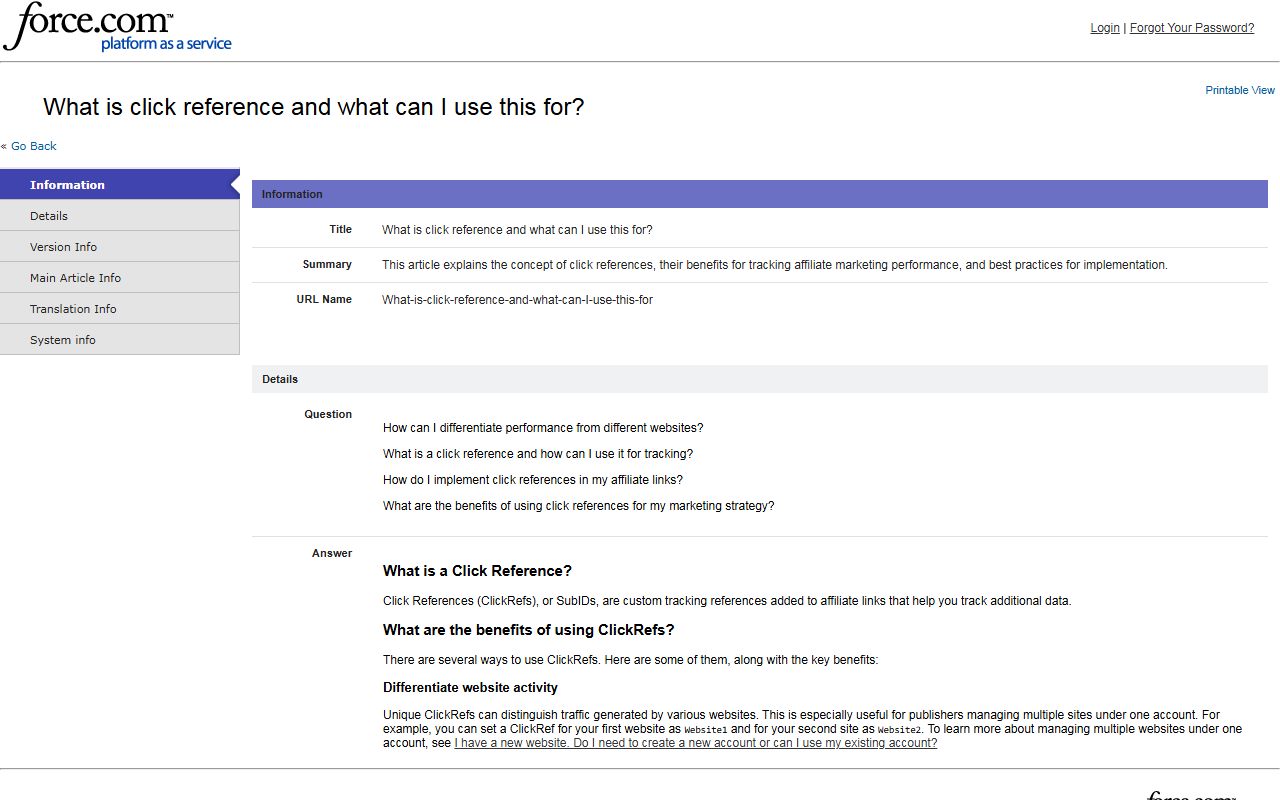
Awin calls the label a click reference. Its help article states that a ClickRef is added to an affiliate link to track conversion activity, and that up to six different ClickRefs can be added per link within the platform.
There is a practical length limit rather than a hard one. The same article advises restricting ClickRef names to 50 characters, or the full reference will not display in the Click Reference report.
Reporting is uneven across the six. Awin says the first ClickRef is available as a report in the platform, while data from ClickRef2 to ClickRef6 has to be exported or retrieved through the Publisher API.
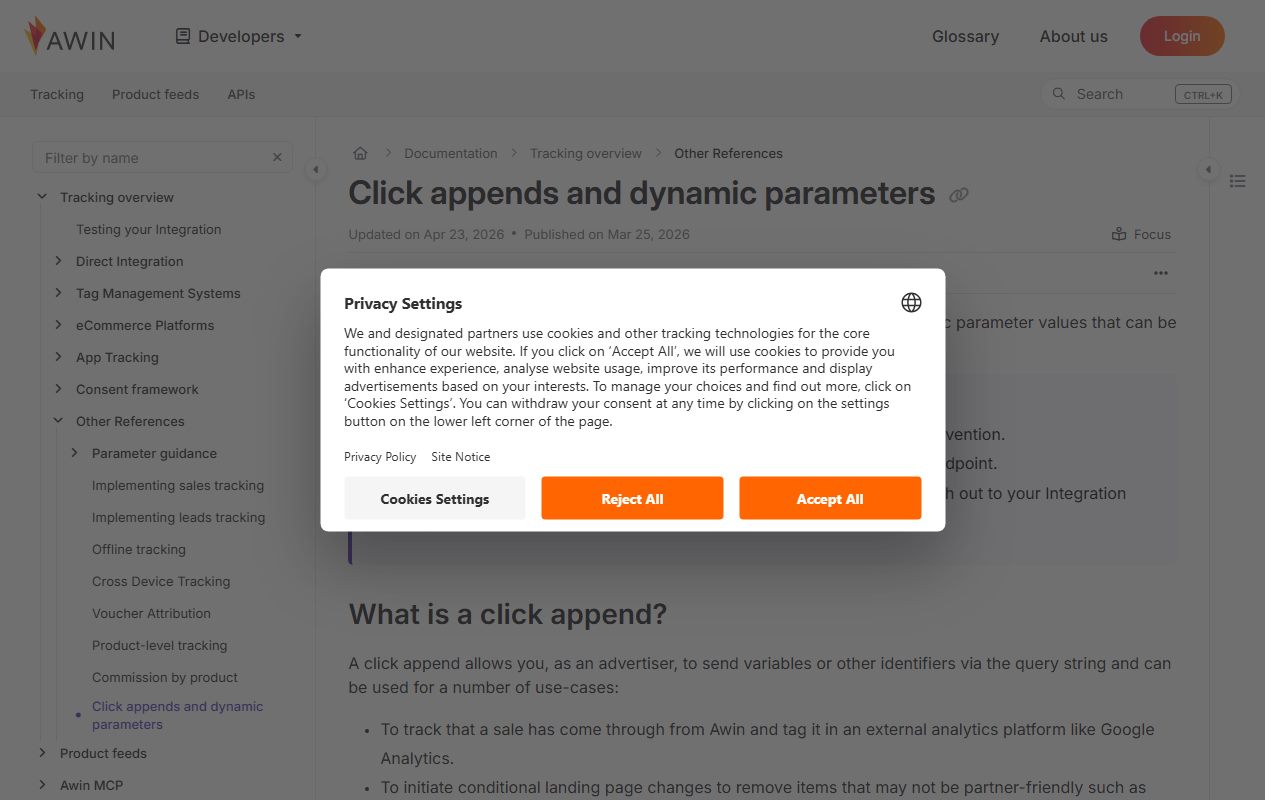
Awin's developer documentation adds a distinction that matters for privacy. The clickref parameter can be returned to the advertiser's landing page, whereas clickref2 through clickref6 are described as non-public parameters that cannot be transmitted there.
Two sibling parameters cover other placements: a ViewRef is added to a banner image to track its activity, and a PRef is a combined parameter usable for both banner images and affiliate links.
Awin also supports dynamic placeholders that its system replaces during the redirect, including codes for the partner identifier, the creative identifier and a unique click identifier.
PartnerStack documents a partner key and a click ID
PartnerStack's published developer documentation describes a different model. When a visitor arrives through a referral link, the partner's key appears in the ps_partner_key query parameter, base-64 encoded, and is stored in a first-party cookie on the vendor's own domain.
A second identifier, ps_xid, is documented as the unique reference to the click event through the partner's link, and is the value a vendor passes to the server-to-server conversion endpoint.
Those are vendor-side identifiers. The link-tracking pages read on October 13, 2026 do not document a partner-facing sub-ID field of the kind Impact and Awin publish.
That is a limit of what we could read, not a statement about the product. PartnerStack's support site did not load on October 13, 2026 through either a direct fetch or a headless browser, because a bot check intercepted both requests.
So any partner-side labelling documented on that support site is unverified here, and worth confirming with the program team rather than assuming parity between networks.
Programs hosted on PartnerStack include several of the larger SaaS affiliate schemes, and which network a program uses is set by the brand, as noted in affiliate vs referral vs partner programs in SaaS.
The track you joined also changes what gets reported, since lead and deal registration programs record a form rather than a click. That split is described in affiliate vs referral vs partner programs in SaaS.
Name the slots before you use them
A label is only useful if it is readable six months later in a report column. These constraints come from the two documentation sets above rather than from preference.
- Keep each value under 50 characters so Awin's Click Reference report shows it in full
- Use letters and numbers only where a value is shared with the brand, as Impact requires for SharedId
- Reserve one slot for the page and one for the placement, since a page can carry several links
- Put nothing personal in a shared slot, because the brand can read it
- Decide the scheme once and write it down, because labels cannot be added to clicks already made
- Add values through the network interface rather than editing the URL by hand
The payoff is a report that answers an editorial question: which page earns, not merely which program pays. That is a different question from how much a program pays over a year, which is worked out in what recurring commission really pays over 12 months.
What sub-IDs cannot do
They do not influence attribution. The label records where a click came from; the program's window and last-click rule still decide whether the click earns anything.
They do not protect a commission either. A labelled action can still be reversed by the brand, and the label will sit on the reversed row unchanged.
And they do not substitute for the program's own rules on permitted placements, which are set out in the agreement rather than in the network's tracking documentation. That reading is described in read SaaS affiliate program terms before promoting.
Bottom line
If a program runs on Impact, three private slots of 255 characters each are available, plus one slot the brand can see. If it runs on Awin, six ClickRefs exist but only the first has a report in the interface.
Set the naming scheme before publishing the first link, keep values short and alphanumeric, and put nothing in a shared slot that a brand should not read.
Then read the resulting rows against the window and status rules, because a labelled click is still subject to the same clock described in how affiliate cookie windows compare across SaaS networks.
Frequently asked questions
What is a sub-ID in an affiliate link?
An extra parameter you add to a tracking link so the click can be attributed to a page or placement in your own reports. Impact calls it a Sub ID; Awin calls it a click reference, or ClickRef.
How many sub-IDs can one link carry?
Impact documents SubId1, SubId2, SubId3 and SharedId, each up to 255 alphanumeric characters. Awin says up to six different ClickRefs can be added per link within its platform, as of October 13, 2026.
Can the brand see my sub-IDs?
At Impact, no for Sub IDs and yes for Shared IDs, which its documentation describes as visible to both partner and brand. At Awin, the first clickref can be returned to the advertiser's landing page; clickref2 to clickref6 cannot.
Where do sub-ID numbers appear?
In partner reporting only. Impact names the Advanced Action Listing and Performance by Sub ID reports. Awin reports the first ClickRef in its platform and requires an export or the Publisher API for the rest.
Do sub-IDs change who gets the commission?
No. They are labels recorded with the click. Credit is decided by the program's attribution rule and window, and a labelled action can still be reversed by the brand afterwards.
Can sub-IDs be added to links already published?
New clicks on the updated link will carry the label, but clicks already recorded cannot be relabelled. That is the practical reason to agree a naming scheme before the first link goes live.
Sources
- impact.com help: Sub ID and Shared ID parameters explained for partners (SubId1-3 and SharedId, 255 characters, visibility) (checked Oct 13, 2026)
- impact.com help: Add reporting information to your tracking links (Advanced Action Listing, Performance by Sub ID, do not edit links manually) (checked Oct 13, 2026)
- Awin: What is click reference and what can I use this for (up to 6 ClickRefs, 50-character guidance, ViewRef and PRef, Click References Report) (checked Oct 13, 2026)
- Awin developer docs: Click appends and dynamic parameters (clickref public, clickref2-6 non-public, dynamic placeholders replaced on redirect) (checked Oct 13, 2026)
- PartnerStack docs: Advanced usage of PartnerStackJS (ps_partner_key query parameter, first-party cookie, ps_xid click identifier) (checked Oct 13, 2026)