How Refund Clawbacks Work in Affiliate Programs
A tracked sale is not a paid sale. Impact lets a brand reverse an action until the locking date, Awin lets an advertiser decline it during the validation period, and PartnerStack holds every commission as pending approval until the program signs it off. Here is what the networks and four SaaS programs publish about refunds, disputes and clawbacks.
This article is a documentation review: it is based on the vendors' own published pages, checked on the date shown. We may earn a commission from some links; it never affects what we recommend.
The word publishers use is clawback. The word the networks use is reversal, decline, or amendment, and each one has a published list of reasons attached to it. A refund is on all three lists. The useful question is not whether a program can take a commission back, because every program we read can. It is how long the window stays open, and whether the money comes out of the sale that caused it or out of your next payment. Impact, Awin and PartnerStack all publish the mechanics. Shopify, Notion, Kinsta and HubSpot publish the brand-side wording. Everything below was read on October 21, 2026.
The locking date is the only hard deadline
Impact's partner help states the rule plainly. While an action is pending, the brand can modify or reverse it. When the locking date arrives, no more changes can happen and the action locks in whatever status it holds.
That date comes from your contract, not the network. Semrush, which runs on Impact, publishes its own: locking happens 27 days after the end of the month, and payment 21 days after the end of the month of locking.
Shopify, also on Impact, locks on a calendar day. Actions are locked on the 21st day of the month for the previous month's actions, and payment is processed one day later, on the 22nd.
Until that date, your pending balance is an estimate. Impact's pending screen documentation warns that the pending amount may change for various reasons and tells partners to check the Reversed Actions screen when it does.
Networks publish the reason codes, and refunds are on the list
Impact's reversal reason table has thirteen entries. Item returned is defined as the consumer having returned the good and the brand having refunded them. Consumer fraud covers an illegal purchase, such as a stolen credit card used at checkout.
The same table includes Credited to another media partner, Not in compliance with terms, Item out of stock, Consumer error, Order error, Partner activity dispute and Test action. Each is a separate ground, and brands usually supply a reason.
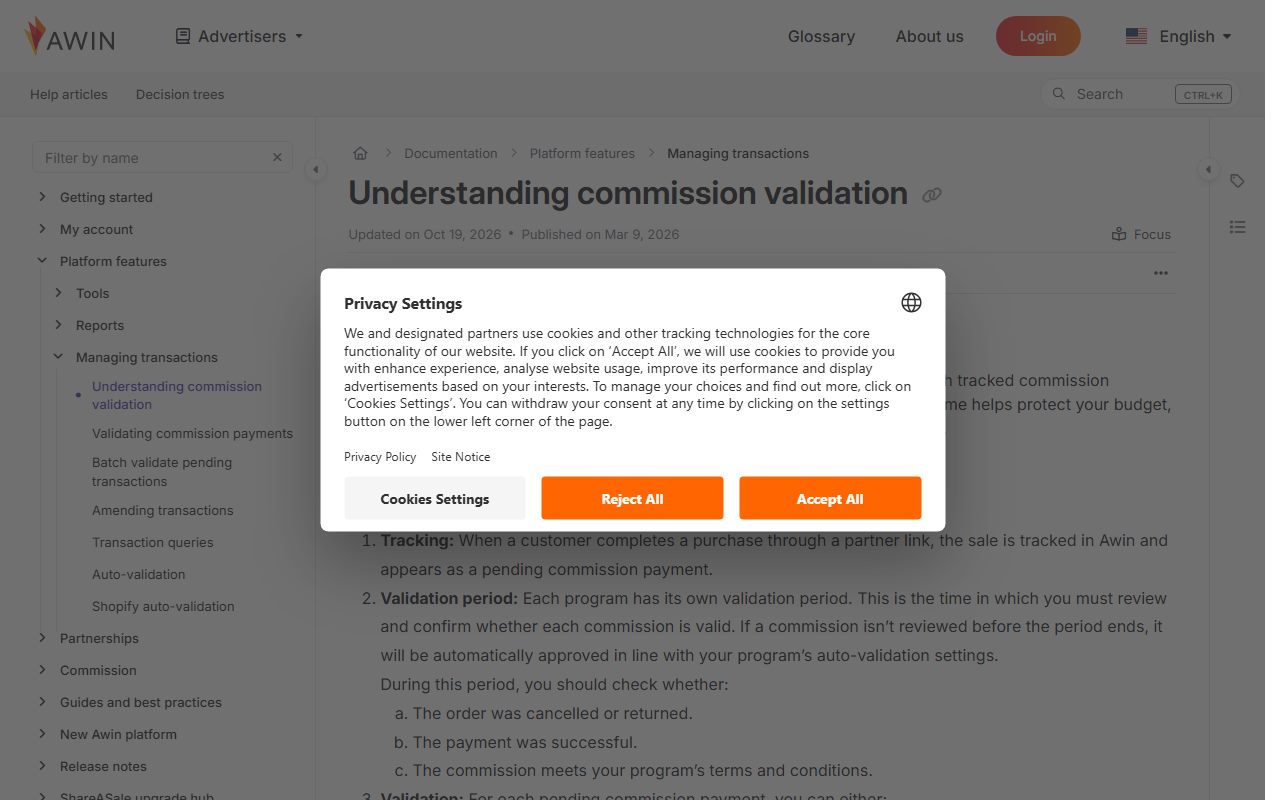
Awin's guidance to advertisers lists five valid reasons to decline: order cancelled or fully returned, wrong marketing source, program terms violation such as illegitimate PPC activity or unauthorised voucher code use, order cannot be fulfilled, and fraudulent sale.
PartnerStack hands the decision entirely to the brand. Its help centre states that the company running the program is 100 percent responsible for approving or declining commissions, and names a refunded customer purchase as an example reason.
Those overlaps matter when you are reading a dashboard row rather than a headline number, which is the subject of how affiliate dashboards count a conversion.
A card dispute appears under a different name
None of the publisher-facing pages we read uses the word chargeback. The situation is there, but it is filed under fraud: Consumer fraud at Impact, with a stolen credit card given as the example, and Fraudulent sale at Awin.
That is a vocabulary gap rather than a policy gap. If you search a help centre for chargeback and find nothing, do not conclude that card disputes are safe. Search for fraud, returned, cancelled and declined instead.
Awin adds a second route to the same result. An advertiser can amend a commission while it is pending, for example when a discount or a return was applied after tracking and the order value needs correcting, rather than declining it outright.
Once validated, that door closes. Awin states that you can only amend commission payments while they are pending, and that after validation the amount can no longer be changed.
Brands publish windows, and two months is the common one
Notion's affiliate FAQ is the clearest. If a user downgrades from a paying monthly plan to a free plan or receives a refund within the first 2 months of the subscription, Notion may claw back the reward or deduct the amount from future commissions.
Kinsta reaches the same place through a qualification period. A referral of Managed WordPress Hosting becomes certified only after the customer has held a paid, active subscription for 2 months and settled all payments.
Its wording on the outcome is blunt. If the referred customer asks for a refund and cancels their Kinsta hosting, your referral becomes void. Recurring commission also stops if the customer cancels their WordPress plan.
Shopify's help centre sets a shorter bar and a standing right. Store plan referrals that do not result in full price payment for at least one month are not eligible, and Shopify reserves the right to reverse any commissions related to fraudulent or refunded stores.
- Impact: brand may reverse or modify any time before the locking date, with a published reason code including Item returned and Consumer fraud
- Awin: advertiser approves, amends or declines during the validation period, and auto-validation approves the transaction if nothing is done within 60 days
- PartnerStack: commissions sit as Pending approval, On hold or Declined, and programs may schedule payouts after a delay to account for trial and cancellation periods
- Notion: refund or downgrade within the first 2 months may be clawed back or deducted from future commissions
- Kinsta: 2-month qualification period, and a refund with cancellation voids the referral outright
- Shopify: at least one month of full price payment required, and commissions on fraudulent or refunded stores may be reversed
A clawback can come out of your next payment
Notion's wording allows either route: claw back the reward, or deduct the amount from future commissions. The second is harder to spot, because the sale that triggered it may be months old by the time the deduction lands.
HubSpot's affiliate program agreement reserves the same remedy in general terms. All amounts payable by HubSpot to you are subject to offset against any amounts owed by you to HubSpot.
HubSpot also caps crediting on the way in. It states that it will not pay more than one commission payment or similar referral fee on any given customer transaction unless it chooses to.
Impact's reattribution mechanism produces a reversal with a replacement rather than a loss. When an action is reversed with the reason System Reattributed Order, a new pending action is created with the same order ID, and only that pending action is considered payable.
After payment, the money is usually safe
Awin draws a firm line at the payment run. Its validation FAQ states that on all plans, commissions and amounts already paid to partners cannot be reversed.
Before that line, the plan decides. On Awin Access, approved commissions cannot be reversed by the advertiser either, while on Accelerate and Advanced the support team can reverse them if the advertiser supplies order references and dates.
Awin's status ladder is worth memorising for this reason. Pending review means the advertiser has not looked yet, Approved means validated but not yet payable, and Payable means included in the next payment run.
The gap between Approved and Payable catches publishers out. Awin states directly that approved does not mean payable, and the payout calendar is what closes it.
Bottom line
Record four things per program before you promote: the locking or validation window, whether refunds are named as a reversal reason, how long the brand's clawback window runs, and whether deductions can come out of later payments.
Then read the terms for the compliance reasons as well as the commercial ones, since Not in compliance with terms sits on Impact's reversal list beside Item returned. The rules it points at are the ones in self-referral, coupon and PPC rules.
A recurring program spreads the exposure rather than removing it, as what recurring commission really pays sets out, while the referrals programs will not pay covers sales that never qualified.
Save a dated copy of every page you rely on, as reading the terms before promoting recommends. A screenshot of the clawback clause is worth more than a memory of it.
Frequently asked questions
Can a brand take back a commission after it is approved?
At Impact, no changes are possible once the action locks on the contract's locking date. At Awin, amounts already paid to partners cannot be reversed on any plan, while approved but unpaid commissions can be reversed by support on the Accelerate and Advanced plans.
Do SaaS programs publish a clawback window?
Some do. Notion names the first 2 months of the subscription for refunds and downgrades. Kinsta uses a 2-month qualification period before a one-time commission is approved. Shopify requires at least one month of full price payment for eligibility.
What happens if a customer disputes the card payment?
The pages we read do not use the word chargeback. Impact files that case under Consumer fraud, defined as an illegal purchase such as a stolen credit card used during checkout, and Awin lists Fraudulent sale as a valid reason to decline.
Can a clawback be deducted from a different sale?
Yes where the program says so. Notion states it may claw back the reward or deduct the amount from future commissions. HubSpot's agreement makes all amounts payable to you subject to offset against any amounts you owe HubSpot.
What if the advertiser never reviews my transaction?
On Awin, auto-validation covers it. The help centre states that if an advertiser has not manually approved or declined a transaction within 60 days, Awin automatically approves it, though some advertisers set no auto-validation period at all.
Why did my pending balance drop without a refund?
Impact lists reversal reasons beyond refunds, including Credited to another media partner, Item out of stock, Consumer error and Not in compliance with terms. Its pending screen guidance tells partners to check the Reversed Actions screen first.
Sources
- impact.com Help Center: Reversed Actions Explained for Partners (locking date, thirteen reversal reasons including Item returned and Consumer fraud) (checked Oct 21, 2026)
- impact.com Help Center: Pending Screen Overview for Partners (pending amount may change, check Reversed Actions) (checked Oct 21, 2026)
- impact.com Help Center: System Reattributed Actions Explained (new pending action with same orderId is the only payable one) (checked Oct 21, 2026)
- Awin help: Understanding commission validation (approve, amend or decline; five valid decline reasons; already-paid amounts cannot be reversed) (checked Oct 21, 2026)
- Awin publisher help: How long does it take for an advertiser to approve a transaction? (60-day auto-validation, validation period field) (checked Oct 21, 2026)
- Awin publisher help: Understanding Transaction Status and Payment Process (Pending review, Approved, Payable; approved does not mean payable) (checked Oct 21, 2026)
- PartnerStack Support: How do I get paid? (commission statuses, brand is 100% responsible for approving or declining, refunded purchase example) (checked Oct 21, 2026)
- Notion Affiliate Program FAQ (refund or downgrade within the first 2 months may be clawed back or deducted from future commissions) (checked Oct 21, 2026)
- Shopify Help Center: Affiliate earnings (one month of full price payment required; right to reverse commissions on fraudulent or refunded stores; lock on the 21st, payment on the 22nd) (checked Oct 21, 2026)
- Kinsta Affiliate FAQ (2-month qualification period; refund and cancellation voids the referral; recurring stops on cancellation) (checked Oct 21, 2026)
- HubSpot Affiliate Program Agreement (offset against amounts owed; no more than one commission per customer transaction) (checked Oct 21, 2026)
- Semrush Affiliate Program FAQ (locking 27 days after end of month, paid 21 days after the month of locking) (checked Oct 21, 2026)