How Affiliate Tracking Survives Cookie Blocking
Safari and Chrome both restrict the cookies affiliate tracking was built on, and the networks have published what they did about it. Impact warns that brands still on gateway tracking can lose up to 13% of attribution, and says 87% of Safari conversions happen within 24 hours of the last click. Awin reports a 12.6% increase in transactions when advertisers add server-to-server tracking. Here is how the mechanics now work, and the small part a publisher controls, as of October 2026.
This article is a documentation review: it is based on the vendors' own published pages, checked on the date shown. We may earn a commission from some links; it never affects what we recommend.
Affiliate tracking was built on cookies that browsers now block. The networks rebuilt it, and they publish how. The numbers below come from their own documentation, not from estimates.
Impact warns of up to 13% attribution drop-off on older setups. Awin reports 12.6% more transactions once advertisers add server-to-server tracking. Neither figure is something a publisher can fix directly.
What a publisher can do is know which programs are exposed, and stop making the small mistakes that still cost clicks. Everything here was read on October 26, 2026.
Safari blocks the method, not the program
Impact describes Intelligent Tracking Prevention as the privacy software Apple employs on Safari to stop malicious sites tracking users. It also obstructs many traditional methods of affiliate tracking.
The method it breaks has a name. Gateway tracking redirects a customer from a partner site to a brand landing page, and the tracking provider uses a cookie to follow that journey across sites.
Impact quantifies the loss for partners. Brands using traditional gateway tracking could potentially experience up to 13% tracking drop-off, which it states would mean losing 13% of payouts with that brand.
Two published facts explain the size of it. Safari blocks certain first-party cookies after 24 hours as well as all third-party cookies instantly, and Impact benchmarking shows 87% of Safari conversions occur within 24 hours of the last click.
Reach does the rest. Impact cites Safari at 15% of web traffic worldwide and 31% in the United States, which makes the exposure material rather than marginal.
The same page records the resolution. As of May 7, 2025, Impact deprecated its ITP compliance filter because all brands have transitioned to an ITP-compliant tracking setup.
Chrome made the same move, later
Impact treats Chrome as the same problem on a different timeline. Its Tracking Protection feature, enabled by default, prevents a customer click journey being shared across sites, even for affiliate tracking.
Its own answer is that the dependency is gone. Impact states it no longer relies on third-party cookie tracking with its Universal Tracking Tag, so Chrome Tracking Protection should not affect partners.
It still recommends moving further. Impact advises brands to use its server-to-server tracking services instead of the tag, and publishes a test using the Chrome flag named Test Third Party Cookie Phaseout.
For a publisher that is a useful signal. A program still leaning on browser-based tracking is a program whose reported numbers will drift, which is the measurement problem behind how affiliate dashboards count a conversion.
First-party cookies are the workaround, and the tag has to be everywhere
Awin frames the same split clearly. Tracking cookies can be set on the advertiser domain, as first-party, or on Awin domain, as third-party, and modern browsers prefer first-party.
Its delivery mechanism is the MasterTag, a JavaScript container tag designed to be added unconditionally to every page on the site, including the order confirmation page.
The installation rules are strict. Awin tells advertisers to exclude payment pages, to keep the tag out of iframes, and to make sure the awc parameter is present on the landing page.
Awin describes the result as ITP-compliant first-party cookie tracking, and says the tag automatically adapts to Chrome Attribution Reporting API improvements with no action required.
Duration is a separate setting. Awin calls 30 days the industry standard for cookie duration while noting it varies by program, which is why windows need checking per program, as in how cookie windows compare.
Server-to-server moves tracking off the browser
The more durable fix skips the browser. Awin describes server-to-server tracking as sending data directly from the advertiser server to its own, bypassing browser restrictions like ad-blockers and cookie limitations.
It publishes the measured gain: Awin data shows a 12.6% increase in transactions when using server-to-server. Its support page also states that server-to-server is required by Awin for all advertisers.
Impact draws the same line. If a brand uses API tracking exclusively it is compliant, and a custom tracking domain on the same domain as the site is generally compliant because third-party cookies are not used.
Consent is not included in that fix. Awin states that server-to-server and consent signals are separate integrations and both are required, because the consent signal enables the cookie cashback and loyalty partners rely on.
Deferred click tracking rebuilds the identifier
One Awin feature deserves a note because it runs without anyone asking. Safari link tracking prevention blocks certain click parameters, which can break attribution before a reader even lands.
Deferred click tracking removes the unique identifier from the initial click, then makes it unique again on the advertiser side. The click travels without the parameter the browser would strip.
Awin says partners do not need to do anything to enable it, and that it has seen thousands of transactions tracked solely using this method. Advertisers do need the MasterTag installed for it to work.
Consent is a gate of its own
Legal consent sits beside the technical problem. Awin states that in general its tracking cookies are not considered strictly necessary, so consent must be obtained in a compliant manner.
There is a narrow exemption. Awin says cashback, loyalty, incentive and reward cookies may be categorised as strictly necessary, and cites guidance from the UK ICO and the French CNIL to that effect.
It also runs one genuinely cookieless path. Awin voucher attribution needs no cookie because the code is manually entered by the end user, so attribution comes from the code itself.
Its cookie hierarchy then decides who wins. Clicks, whether the standard _aw_m_ or incentive _aw_sn_ cookie, override soft clicks, and soft clicks override the postview awpv cookie.
What a publisher actually controls
Two things, and both are small. The first is protocol. Impact warns that if a user clicks an http link, Safari and Chrome will prevent its cookies from saving the needed tracking information.
Impact serves tracking links over https by default, and tells partners to review their links in case that default was ever overridden manually. Links built by hand are the ones to check, as in how affiliate deep links work.
The second is expectation management. PartnerStack states that if a customer signs up on a different browser or device from the one that clicked, the purchase will not be tracked.
The same page lists cleared caches and blocked cookies as separate failure cases, and tells companies they may add the customer and attribute them to the partner manually.
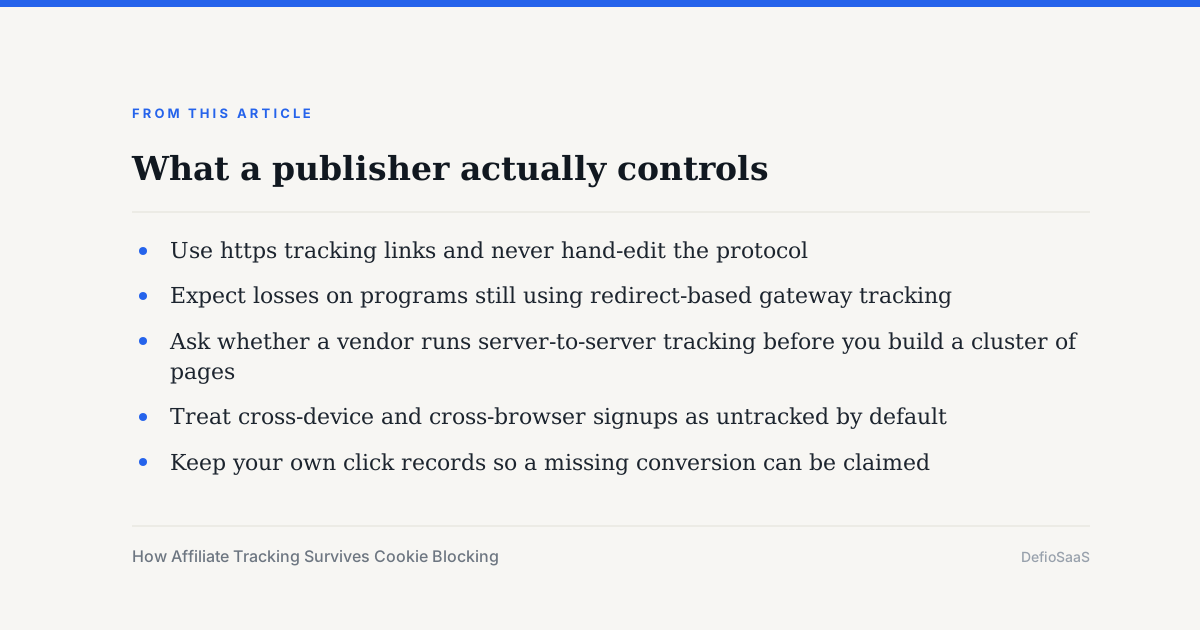
- Use https tracking links and never hand-edit the protocol
- Expect losses on programs still using redirect-based gateway tracking
- Ask whether a vendor runs server-to-server tracking before you build a cluster of pages
- Treat cross-device and cross-browser signups as untracked by default
- Keep your own click records so a missing conversion can be claimed
- Read the program cookie duration rather than assuming the 30-day standard
Bottom line
The cookie era is over and the networks have already migrated. The published drop-off risk now sits with individual brands that have not finished the work.
That makes tracking quality a selection criterion, not just a technical footnote. It belongs in the same review as the clauses in reading the program terms first.
It also explains gaps that look like theft and are not. A conversion lost to a 24-hour cookie expiry leaves no trace, unlike the filtered clicks described in how networks define prohibited traffic.
Finally, keep your own measurement honest. Page-level reporting through sub-IDs and payout mechanics such as currency conversion both assume the click was recorded in the first place.
Frequently asked questions
Do affiliate links still work now that third-party cookies are blocked?
Yes, on current setups. Impact states it no longer relies on third-party cookie tracking with its Universal Tracking Tag, and Awin uses first-party cookies through its MasterTag plus server-to-server tracking.
How much commission does Safari tracking prevention cost?
Impact publishes up to 13% drop-off for brands using traditional gateway tracking. It attributes that to Safari blocking certain first-party cookies after 24 hours, with 87% of Safari conversions landing inside that window.
What is server-to-server affiliate tracking?
Conversion data sent from the advertiser server directly to the network, with no browser involved. Awin says this bypasses ad-blockers and cookie limitations, and reports a 12.6% increase in transactions when it is used.
Will a cookie banner stop my referral being tracked?
It can. Awin states its tracking cookies are generally not strictly necessary, so they depend on consent, with a narrow exemption for cashback, loyalty and reward cookies recognised by the ICO and CNIL.
Does it matter if my affiliate link uses http?
Yes. Impact warns that if a user clicks an http link, Safari and Chrome will prevent its cookies from saving the tracking information. It serves links over https by default, so avoid editing them by hand.
What happens if the reader buys on a different device?
Usually nothing is credited. PartnerStack states that if the customer signs up on a different browser or device from the one that clicked the link, the purchase will not be tracked.
Sources
- impact.com Help Center: Intelligent Tracking Prevention Explained (gateway tracking, up to 13% drop-off, 87% of Safari conversions within 24 hours, Safari at 15% worldwide and 31% in the US, ITP filter deprecated May 7, 2025, https links) (checked Oct 26, 2026)
- impact.com Help Center: Does Google's Cookie Blocking Affect my Tracking? (Chrome Tracking Protection, no reliance on third-party cookies with the Universal Tracking Tag, server-to-server recommendation, Test Third Party Cookie Phaseout flag) (checked Oct 26, 2026)
- impact.com Help Center: Determine your Program's ITP Compliance (API, FTP and e-commerce integrations already compliant, custom tracking domains on the same domain, irclickid parameter) (checked Oct 26, 2026)
- Awin help: Understanding cookies in affiliate marketing (first-party versus third-party cookies, 30 days described as the industry standard, link parameters) (checked Oct 26, 2026)
- Awin help: Understanding Awin MasterTag (JavaScript container tag added unconditionally to every page, excluding payment pages, not in iframes, awc parameter, ITP-compliant first-party cookies, Chrome Attribution Reporting API) (checked Oct 26, 2026)
- Awin help: Server-to-server tracking (direct server data, bypassing ad-blockers and cookie limitations, 12.6% increase in transactions, required for all advertisers, consent signals as a separate integration) (checked Oct 26, 2026)
- Awin help: Awin MasterTag's deferred click browser tracking (Safari link tracking prevention, identifier removed and remade advertiser-side, no partner action needed) (checked Oct 26, 2026)
- Awin help: Cookie consent settings (tracking cookies generally not strictly necessary, cashback and loyalty exemption, ICO and CNIL guidance, cookieless voucher attribution) (checked Oct 26, 2026)
- Awin help: Awin cookie types and attribution hierarchy (_aw_m_, _aw_sn_, soft click and awpv postview cookies, clicks override soft clicks override postview) (checked Oct 26, 2026)
- PartnerStack: Potential cases where link tracking fails (different browser or device not tracked, cleared cache, blocked cookies, manual customer attribution) (checked Oct 26, 2026)