Can You Put Affiliate Links in Email Newsletters?
Some programs allow affiliate links in email, some ban them, and the law applies either way. This guide reads the published clauses and the FTC's own compliance guide.
This article is a documentation review: it is based on the vendors' own published pages, checked on the date shown. We may earn a commission from some links; it never affects what we recommend.
An affiliate link in a newsletter is governed twice: once by the program's terms, and once by email law. The two sets of rules do not say the same thing, and one program read for this guide allows the link while banning its own logo.
That combination is easy to get wrong in a template built once and reused weekly. Every quotation below was read on the source pages on October 31, 2026.
Amazon permits the link, with one condition
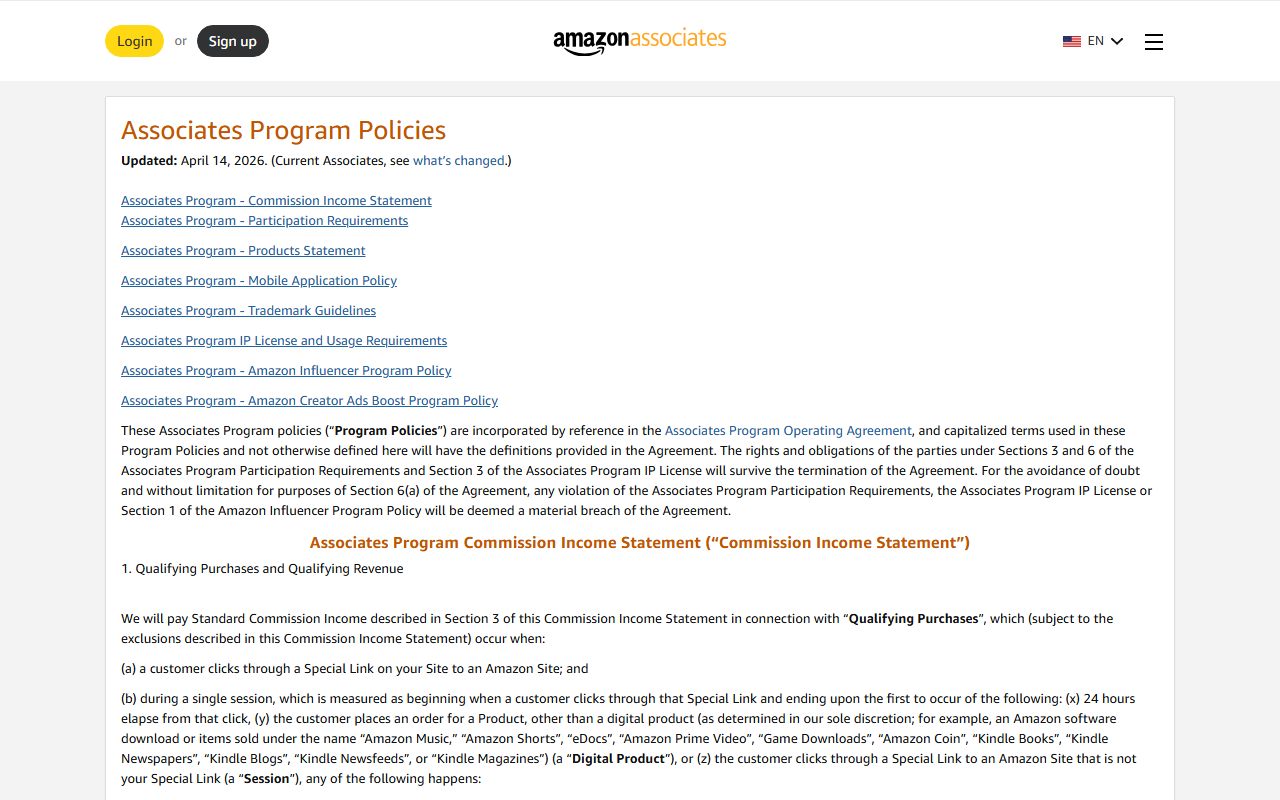
Amazon's Associates Program policies address email directly. They state: "You may include Special Links in emails, SMS and direct messaging from your social media Sites; provided, that such communications are solicited".
The agreement then defines solicited in the same breath, as "opted into by the receiving customer". A purchased list, a scraped list or an untargeted blast falls outside the permission, not merely outside good practice.
The wider ban around that permission is broad. You may not run promotional activities "in any offline manner", including using program content or a special link "in connection with any printed material, ebook, mailing, or any oral solicitation".
So the link is allowed in an opted-in email and not allowed in a PDF lead magnet or an ebook. Many newsletters attach exactly that kind of file.
The logo is banned in the same email the link is allowed in
Amazon's trademark rules carve email out explicitly. You may not use or display the marks "in offline material or email (e.g., in any printed material, mailing, SMS, MMS, attachment to email, or other document, or any oral solicitation)".
Read together with the link permission, that produces an odd but clear result. A text link to the store is permitted in a solicited email; the brand's logo beside it is not.
There is an audit hook attached as well. The policies state that on request you will provide "representative sample materials and written certification" that you have complied, and that failing to certify is a material breach.
Keeping a sent archive of every campaign is therefore not housekeeping. It is the only way to answer that request later, and the agreement attaches a consequence to not answering it.
Smaller programs set a relationship test instead
Surfer's affiliate terms take the stricter route. They forbid sending "fax, email, or text messages to anyone with whom you do not have an established business relationship, or who has not given prior express consent".
Mass telemarketing and automatic calling devices are banned in the same clause, together with "pre-recorded or artificial voice messages". The clause then makes compliance with privacy and unsolicited communications law your responsibility.
HubSpot's affiliate agreement attacks the sourcing side rather than the channel. It prohibits "sourcing leads through compilations of personal data such as phonebooks", along with fake redirects and automated lead generation.
None of those three programs bans newsletters as such. All three ban the version of a newsletter where the recipient never asked to be on the list.
CAN-SPAM applies to one email as much as a blast
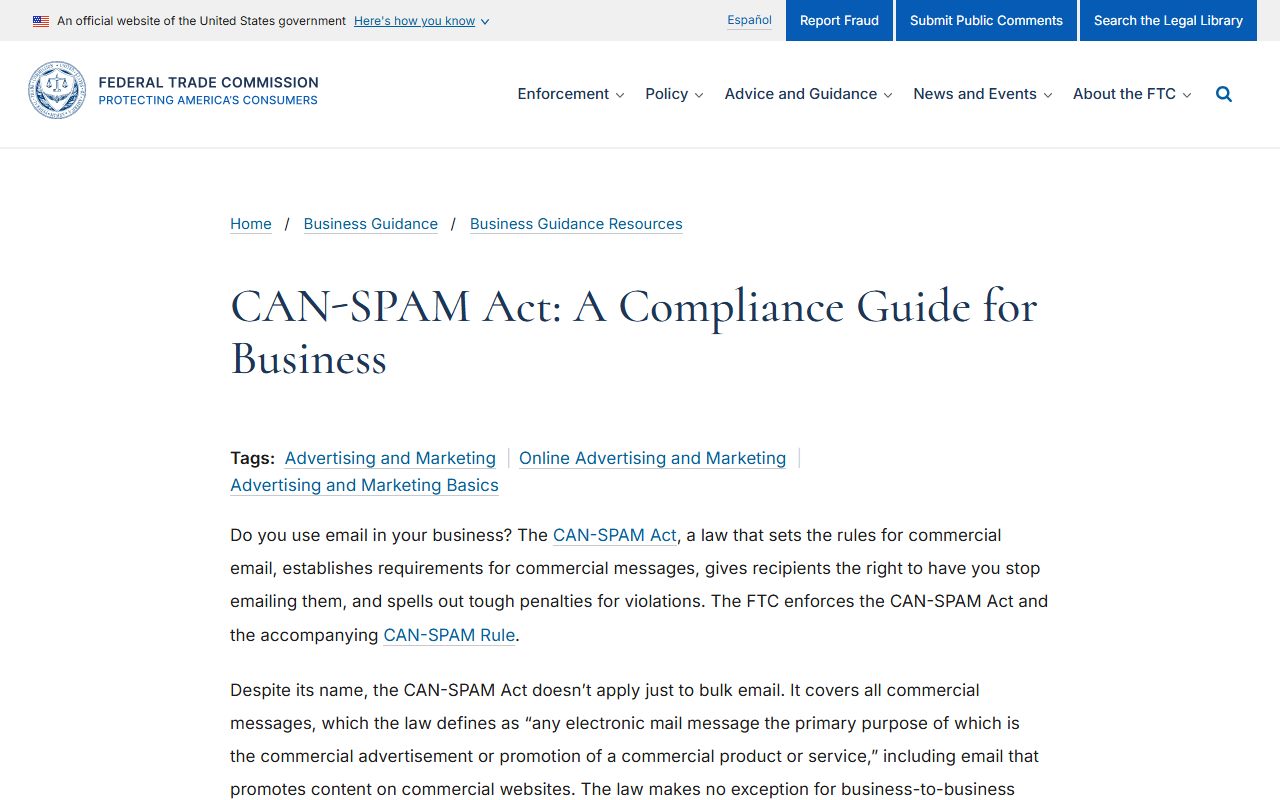
The FTC's compliance guide removes the usual excuse. It states: "Despite its name, the CAN-SPAM Act doesn't apply just to bulk email," and covers all commercial messages, "including email that promotes content on commercial websites".
There is no business-to-business carve-out. The guide says: "The law makes no exception for business-to-business email," which matters for a SaaS review site writing to founders and operators.
The penalty is per message. The guide, noting that it was edited in January 2024 to reflect inflation-adjusted maximums, states that each separate email in violation "is subject to penalties of up to $53,088".
Four requirements are mechanical and easy to audit in a template. The message must disclose "clearly and conspicuously that your message is an advertisement" and must include "your valid physical postal address".
The opt-out has two deadlines. Any opt-out mechanism "must be able to process opt-out requests for at least 30 days after you send your message", and you must honour a request "within 10 business days".
The guide also limits what you may demand in exchange. You cannot charge a fee or require personal information beyond an email address, or ask for more than a reply or a visit to a single web page.
The program makes you the Sender
Amazon's policies assign the legal role to you in writing. For the purposes of marketing laws, including "the CAN-SPAM Act of 2003, the Telephone Consumer Protection Act of 1991", you are "the 'Sender' of each communication containing any Special Links".
That sentence is the whole risk allocation in one line. The brand supplies the link; the liability for the envelope it travels in sits with the publisher.
- An opted-in list, with the opt-in evidence retained.
- A clear statement that the message is an advertisement.
- A valid physical postal address in the footer.
- A one-click unsubscribe that works for at least 30 days after sending.
- A process that honours unsubscribes within 10 business days.
- Text links rather than vendor logos, where the terms ban marks in email.
- An archive of every send, in case a program asks for sample materials.
Disclosure travels with the link
The commission disclosure is a separate duty from the advertisement label. Both belong in the email, and the placement rules are the ones set out in how to disclose affiliate links under the FTC guides.
Tracking behaves differently in email too, because the click arrives without the referring page. Tagging it is worth the effort, as how sub-IDs show which page earned a commission explains.
If the link points past the homepage, check it is a form the program supports. The mechanics are covered in how affiliate deep links work in SaaS programs.
Frequently asked questions
Can I put affiliate links in my newsletter?
In Amazon's program, yes, if the list is opted in. Its policies permit special links in emails, SMS and direct messaging provided such communications are solicited. Surfer's terms require an established business relationship or prior express consent.
Can I use the vendor's logo in the email?
Not in Amazon's case. Its trademark rules bar use or display of the marks in offline material or email, including attachments. The text link is permitted in the same message where the logo is not.
Does CAN-SPAM apply to a small newsletter?
Yes. The FTC guide states the Act does not apply just to bulk email and covers all commercial messages, including email promoting content on commercial websites. It also states the law makes no exception for business-to-business email.
What has to be in the email itself?
Four mechanical items per the FTC guide: a clear and conspicuous disclosure that the message is an advertisement, a valid physical postal address, an explanation of how to opt out, and accurate header and subject information.
How fast must I process an unsubscribe?
Within 10 business days, and the mechanism must keep working for at least 30 days after the message was sent. You cannot charge a fee or require information beyond an email address to honour it.
Who is liable if the email breaks the rules?
The publisher, by contract. Amazon's policies state that for applicable marketing laws, including CAN-SPAM and the Telephone Consumer Protection Act, you are the Sender of each communication containing special links.
Can I put affiliate links in a PDF or ebook?
Not in Amazon's program. Its policies bar promotional activities in any offline manner, naming printed material, ebooks, mailings and oral solicitation, and that ban covers program content and special links alike.
Bottom line
A complete email rule would say whether links are allowed, whether marks are allowed, what counts as a solicited list and who is the sender. Amazon publishes all four. Surfer and HubSpot publish the consent test and stop.
Build the footer once and keep the archive, because the obligations are per message. The surrounding traffic rules are in how networks define prohibited affiliate traffic.
The promotion limits sit in the same part of the contract, alongside self-referral, coupon and PPC rules in affiliate terms and the reading routine in how to read SaaS affiliate terms before you promote.
Sources
- Amazon Associates Program Policies, Participation Requirements and Trademark Guidelines (checked Oct 31, 2026)
- FTC - CAN-SPAM Act: A Compliance Guide for Business (checked Oct 31, 2026)
- Surfer Affiliate Program Agreement, promotional restrictions (checked Oct 31, 2026)
- HubSpot Affiliate Program Agreement, lead sourcing restrictions (checked Oct 31, 2026)